

Ian Love Design
American

505 Lincoln street
Riverhead, NY 11901
United States
Showrooms
Showrooms
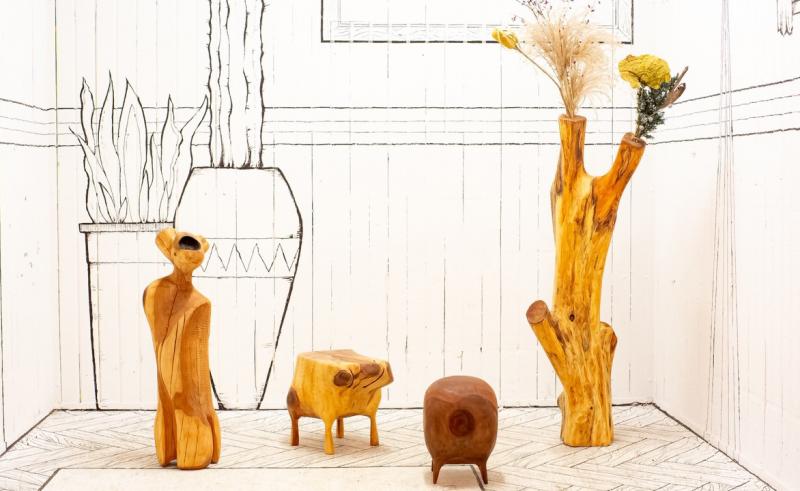
Ian Love's handcrafted collection of design and functional art pieces includes resin-filled burl sculptures and objet, large-scale spalted wood dining tables and daybeds, multi-purpose room dividers, storage and case pieces, tabletop items and home goods, charming headboards, trunk or root-based suspended lighting systems and chandeliers, mirrors and mixed-media wall art, benches, and an incredibly diverse line of hand-carved stools with playful variations on leg designs and stump bases.
With an innate attraction to spalted (diseased) wood because of its marbled character, Ian’s mediums span all genus of timber: cherry blossom, walnut, oak, cedar, maple, elm, hickory; as well as resin, concrete, alabaster, stone, metals and mixed-media found flora. A constantly evolving practice, Ian’s signature hand-chattered imprint finds itself into many of his designs, validating an appreciation of the imperfect in his holistic design concepts and their unconventionally beautiful finished products.
About Ian Love Design
Designer Ian Love had been a career musician for his entire career until six years ago, when tremendous tragedy struck his family. His life was drastically reoriented, with his priorities and creative perspective following suit. The half decade of adversity persists in its effects, but the forced shifts in his thinking and approaches to living because of it are not lost on him. One deceptively inconsequential shift was that Ian was driven to gardening; the only respite he could find from his family’s turmoil was in the soil, working with his hands, and learning about botanical systems and their cyclical interplays with life, growth and death. At his home on Long Island he expanded on this idea of working with his hands – an inclination whose nascence lies in his having played instruments for so many years – beginning woodworking projects with his daughter. The practice eventually developed into furniture making, a critical turning point toward the design business he’s built today.
The Singular Tree Concept
Also rooted in Long Island is Ian’s proprietary Singular Tree Concept. Though not exclusive to his
creative practice, the terminology applies to his dedication to using entireties of wood pieces,
which he locally sources from a fallen tree farm in Speonk. In an industry in which designs are
determined with little flexibility, materials waste is often very high, because no standardizations
apply to using leftovers for additional, potentially complementary projects. Ian’s approach, on
the other hand, is to source material first; the designs come second, upending the hierarchy to
reprioritize the resource of wood and to let it determine what can be made of it. Because Ian is
making use of trees’ full remains in his product line, his work ranges from large-scale furniture
to smaller objet, and eschews a customary, seasonal collection concept in order to produce
according to the materials made available to him by the constraints of nature's refuse.
An Intuition-Driven Process
The sustainability of his design approach relates to the mysticism that underlies it; in the same,
personally tumultuous five-year timespan during which his brand and creative practice
developed, he began a practice of transcendental meditation to calm his nerves through it all.
With no professional schooling and a process based nearly entirely on material-maker intuited
connection, Ian’s work in turn emerges from some semblance of a collective unconscious. His
meditation is about leaning into and trusting the intuitive process, and he receives the
strongest response to his work from people who cite relationship to it on an emotional or
cognitive level, as if it’s sparking an image, feeling or memory from their own, archetypally
familiar unconscious.
The emotionality and the self-taught, experimental nature of Ian’s process are jointly
informative of his creative trajectory. His intentions to appreciate material life in its perfected
and marred forms alike, and to create desirability from refuse, together form the basis for his
growing collection of design objects.